
ISKM61 MOOC: learning online
Study journal
Because this course is taught in English, I will write my journal in English as well. There is no word limit or minimum length for the reflections. For my first course, I chose: Making creativity and innovation happen. I should dedicate 3 – 4 hours a week to my MOOC studies.
Week 1
Making Creativity and Innovation Happen
Honestly, studying this week was hard because the system of this MOOC is very boring. There is a lot of text and almost no videos or pictures. If I didn’t have to study this because of school, I would probably drop it in the second chapter. I don’t have any other motivation to finish the course, and I often feel like it’s just an obligation.
Because the course is in English, I had to translate a lot of words. Sometimes I had to read a paragraph three or five times just to understand it. I think I was trying to be too quick to finish the course as fast as possible, and that blocked me from focusing. I realized I get exhausted and need a break after half an hour. Later in the week, I tried making some tea to calm down and translated the whole web page into Czech. That worked much better. I also found out I can focus quite well when studying on the train.
Even though I struggled with the text, some parts were interesting. I really liked the video about „creative confidence“ and the „expert myth.“ People often think they must be experts to come up with an idea, and they are scared to say it out loud. I actually have the same problem and want to overcome it. Watching a short video was a much better way for me to understand than reading.
Chapter 4 about failure was also motivational for me. The text said that errors can teach you what not to do. I reflected on my own life: I chose a wrong partner when I was 18, but I learned a lot of things that help me in my relationship now. Even though I know failure is nothing bad, I am still afraid of it. I also liked thinking about „tame“ problems (like homework) versus „wicked“ problems (like mental health).
If I were rebuilding this course, I would cut a lot of the text and add way more videos. It also needs a lot more interactive parts. Right now, there is actually nothing to work on. I can just go through the text even if I don’t read it. I would add some text fields where I actually have to write something, and it wouldn’t let me in the next chapter if I didn’t fill it out. I actually think this lack of interaction is why so many people don’t finish MOOC courses in the first place. Next week, I will stick to studying for just 20 or 30 minutes at a time, because I know I can’t focus for 50 minutes straight. I will also try to take more notes, but I don’t know if it will help me.
Week 2
I was quite distracted this week and struggled to focus because of the long texts and lack of videos (as I stated in my first reflection). In one activity, the video link didn’t even work. I ended up browsing Instagram or looking for other courses. To keep myself engaged, my coach suggested ElevenLabs to create a podcast out of the material. I had to spend some time figuring out how to use the tool and getting to know its UI, but thanks to ElevenLabs, I found out that audio is a much better way of learning for me. Because I was curious, I also discovered that Gemini Pro can read text out loud, so I translated the course into Czech and had it read that to me. I even tried DeepL, which was really bad, but at least it made me laugh. In the end, though, ElevenLabs was definitely the best.
While using these audio tools, I figured out a good trick to stay focused. When I just read or listen, I don’t know what to do with my hands and I feel uncomfortable. I realized that doing errands around the house while listening to the course is a much better approach for me. Because the course is not interactive, changing how I study helps me give it an interactive part myself.
Along with finding new ways to focus, I realized it was quite tough for me to plan my learning. I am still figuring out the best study tactics. I initially studied every day for one hour, starting on Tuesday. But I realized that I don’t like having unfinished tasks, so I rethought my plan. I switched to doing it all in one sitting instead, and it worked really well for me. I will definitely do it the same way next time. I also found out that taking a break after 30 minutes works best for me.
Even with all the distractions and schedule changes, I learned some fascinating things. In the lessons on Japan, I found it intriguing how they try to convert tacit knowledge into explicit knowledge. I didn’t know that was possible. Also, the chapter about communication reminded me of a book I was reading recently called The Diamond Sutra by Osho. He wrote about how the sutras say „he heard something“ instead of „someone said it.“ This is because a person interprets things in their own way and can change the meaning of what they hear, which is a very important part of communication.
Week 3
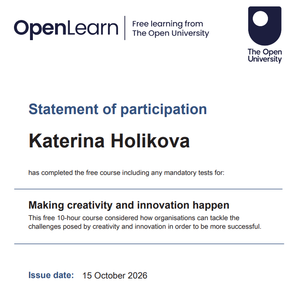
This week I finally completed the Making creativity and innovation happen course and received a certificate!
It was a bit of a struggle at the end. For example, the chapter on „Brain circulation“ was mostly just text, and honestly, I wasn’t really focused on it. It didn’t really grab my attention, though it was quite cool to learn how know-how transfers from Silicon Valley to China and India’s indigenous industries. Just like I figured out last week, sitting still doesn’t work for me, so when it came to the video on how to lead a successful global team, I just listened to it while I was cleaning the kitchen. However, thinking about your question from last week—how this differs from background music and how much actually stays with me—I realized that just listening while doing chores isn’t always enough. If the text is dry, it really can turn into background noise. I found out that the most effective way for me to actually retain the information is to read the chapter afterward while listening to the audio at the same time. Combining both listening and reading is what truly makes it stick.
We also covered taking a strategic approach to creativity and innovation, which listed five key approaches (like redefining the who, what, and how). The theory is nice, and it would be great to actually see someone do it in practice. But honestly? I find it ridiculous how some companies don’t have strategies at all, and if you actually ask them what their strategy is, they just answer with something they’ve made up on the spot. Unfortunately, I think it happens way too often.
This really tied into the activity about business model innovation. The course talks about using a structured framework to pivot or change directions. But my answer to that is, again, the corporates that I know usually don’t want any real innovation because it is just too much work. They would have to migrate so much data that it’s just not convenient for them. They say in the media that they are innovating, but usually, it’s in fields that are not necessary, or they do automations that are just not worth it. They can say they did something, but it’s useless. The important thing is that when a large company is innovating, they need to do it as a whole. You can’t just innovate every part separately, because there can be unintended consequences.
By the time I got to the very last section on disruptive innovation, I ran out of credits on ElevenLabs. I needed to figure out some other way to generate text-to-speech, but I honestly just didn’t have the will to look for another tool. So, I just forced myself to read the text after all.
Starting the Prepare and visualize data with Microsoft Power BI course.
My first impression is great. It has a modern UI and is clearly divided into modules. Although I didn’t fully grasp all the theory in the intro module right away, I knew it would make sense once I started using it. What really works for me here are the „Knowledge checks“ at the end of the modules—I got 2 out of 3 right, and it forced me to re-read what I missed. Plus, getting an achievement badge afterward gives me a nice sense of accomplishment.
The biggest takeaway for me this week, though, was figuring out where I study best. I did the modules during 20-minute breaks between lectures at uni, and I could fully focus without any distractions. I noticed the exact same thing when studying on the train—because I had nothing else to do there, I just concentrated on the course. I realized I need to change my environment like this more often. At home, I get easily distracted by chores and other tasks. Turning text into audio and doing errands worked for the previous theoretical course, but it definitely won’t work here since Power BI is very hands-on.
The second module about getting data looks super interesting, especially connecting to SQL and NoSQL databases or simple „flat files.“ I even laughed at a very realistic course scenario about HR stubbornly keeping data in Excel instead of implementing an SQL database. I also finally downloaded the Power BI Desktop app—having to log in everywhere multiple times just to get it was pretty annoying, but I’m ready for the practical part now.
Week 4
This week, I continued with the Power BI course.
This time I tried something new: dictating my notes via microphone while translating the text to Czech out loud. Honestly, it was an absolute game-changer. Hearing my own voice literally kept me awake and focused, preventing me from zoning out. Plus, by dictating, I capture way more details than I would by typing, which stops me from forgetting important points. The biggest realization, though, is that explaining things out loud to myself helps me remember the material so much better. It is a perfect fit for this kind of learning—I really wish I had thought of doing this for the previous theoretical course. I am definitely going to keep using this strategy from now on.
And I really needed that trick, because the structure of this part of the course was pretty frustrating. We went through getting data from files, relational databases, NoSQL, online services like SharePoint, and dealing with storage modes. The problem was that it was almost entirely theoretical text and scenarios. Because there was just so much written information, I started feeling confused and overwhelmed. I kept wondering what exactly I was supposed to remember from it all and how the module would even end. I was really hoping for a quiz to anchor my knowledge, because it is simply impossible to memorize everything just by reading it without immediate practice. It would be so much more effective to have mini-exercises after every module rather than just one massive lab at the very end.
When I finally reached the actual practical part, „Exercise – Get data in Power BI,“ it was a relief. I had to use a virtual machine, download some files from GitHub, and connect to a local SQL server. The step-by-step guide with pictures was great, though navigating through a bunch of unknown tables with endless columns was a bit confusing at first since I didn’t know the data context at all.
Just like my experience with the introductory module, the Knowledge checks at the end saved the day. I scored 2 out of 3 on the final one—I totally blanked on what language is used for extracting data from an SQL server, so it forced me to go back and re-read. Overall, discovering how well microphone dictation works for my memory was my biggest takeaway this week.
Week 5
This week, I continued with the Power BI course, focusing on the third module: “Clean, transform, and load data in Power BI.” I gave up on dictating my notes directly into OneNote because the constant microphone issues were too frustrating. Instead, I decided to just record myself doing the tasks and plan to transcribe the recording afterward.
I finally reached the practical part of the course. The lab was supposed to take 45 minutes, but it took me about an hour. I worked with a prepared sales dataset in a virtual machine and used Power Query Editor to configure several queries. I renamed queries and columns, selected and filtered data, replaced values, changed data types, merged tables, created a new column, and finally loaded the queries into the model. I was relieved when the row and column counts in the status bar finally matched the instructions.
However, the exercise was much more confusing than I expected. Some steps were incredibly difficult to follow because the instructions didn’t show exactly what I should click or what the result should look like. I got stuck on filtering a column and later on merging queries, and at one point I had to go back and start a whole section of the exercise again because of one missed step. I kept thinking that a simple screenshot would have saved me so much time. The later steps were easier when the course actually showed where to find an option or what the expected result was. By the end, I had configured all eight queries, but I’m honestly not sure I’d remember every step without reviewing the instructions again.
I also found it hard to stay interested in the generic sales data because I didn’t really understand the context behind it. Working with anonymous sales figures, regions, and product categories felt abstract and disconnected. I think this kind of exercise would be much more engaging if I could work with data from a topic I actually know or care about. To answer your question from last week’s feedback, I definitely think small practical tasks in between the theory-heavy modules would help. Since the prepared files were only available in the virtual machine, I couldn’t experiment with them in Power BI while studying the theory. Next time, I want to keep Power BI open alongside the reading material and explore where the different tools are, even if I cannot use the exact same data.